The Greatest Danger to Adventist Innovation
#09A call for Early Adopters.
In the last post we focused on the first stage in the adoption bell curve... Innovators. In this post we focus on what may actually be the most important stage... Early Adopters.
Innovation theory describes five groups in how new ideas spread: innovators (the builders), early adopters (the first believers), the early majority (joins after proof), the late majority (joins once it is standard), and laggards (the last to move).
Innovation is essential... but without early adopters, innovation never takes off.
Between innovators and the early majority lies a chasm that only early adopters can bridge.
And Adventism rarely produces them.
Innovators are the match...
Early adopters are the kindling...
The early majority is the log.
You can have a match, and you can have a log...
If you do not have kindling, you do not have a fire.
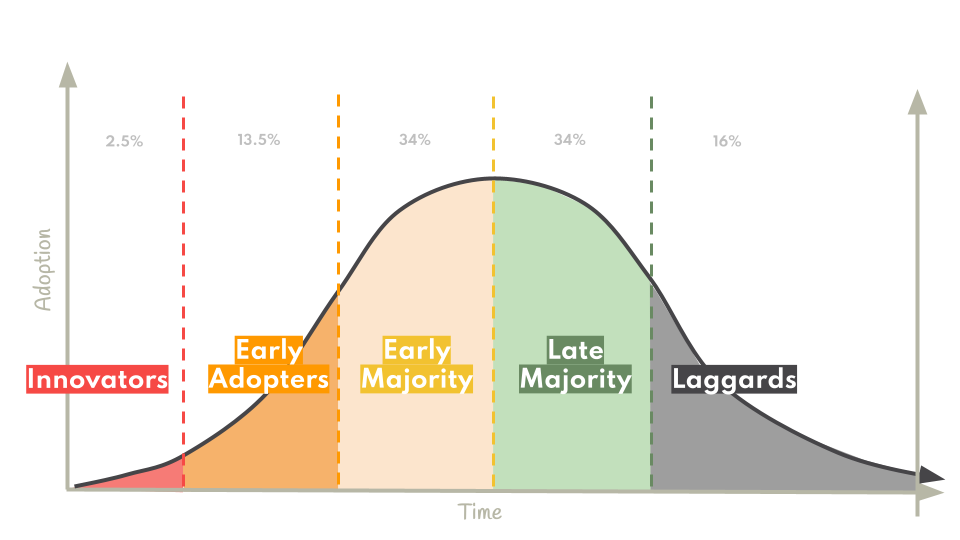
The early-adopter gap
We have innovators... lonely founders building prototypes in basements, spare rooms, at the back of churches. These are people driven to serve God through innovation.
We also have early majority members who join once everything is safe, polished, and institutionalized… when there's a conference logo on it, a GC statement about it, a NAD handbook around it, or at least a glossy brochure and a thirty-year track record.
What we don't seem to have is a culture that says:
Let's believe before it's obvious.
Let's support the unproven because the calling is clear.
Instead, the ecosystem does this quiet calculus... walk into any Adventist innovation pitch and you'll hear it within the first five minutes:
Has anyone tried this yet?
Is this approved?
Circle back once other churches adopt it.
There is no hostility in the tone... only caution. A polite deferral. As if innovation must first survive the judgment of some invisible committee before it becomes real.
Underneath those words lies a deeper truth.
The Adventist ecosystem has virtually no early adopters.
And in a movement that was born through stepping out in faith, that is more than just a strategic flaw... it is a spiritual contradiction.
Ideas die in seed form because Adventist culture rarely funds or supports something until it is already proven.
We Reward Proof, Not Pioneering
Here is the uncomfortable pattern we keep repeating…
We do not lack money, and we do not lack mission talk. What we lack is a culture that treats early stage building as legitimate work for God. Our reflex is to support what is already established, already stable, already socially safe.
That is why so many Adventist builders experience the same quiet rejection. They bring a seed... and we ask for a tree.
Take ASI and OCI… they have supported real work, real people, and real outcomes. But in practice, most of their attention tends to gather around ventures that already look like something familiar... something with a track record, a board, a brand, and a story that can be told at a convention. That is not wrong, its just their model… but it is also exactly why the seed stage keeps starving.
And if you want a historical mirror, look at Madison.
Madison was not immediately embraced. It was questioned, resisted, and treated as an outlier... until its fruit became undeniable. Then it was celebrated, referenced, and held up as a model.
We love Madison as a story now because it is safe now. It is a museum piece. But in its own time it was not safe... it was a living rebuke to comfortable concepts and centralized dependence. The pattern is painfully consistent: we withhold support when something is small and vulnerable, we demand social proof before we offer faith, and then we rewrite history once the outcome is obvious. We act like we want Adventist entrepreneurs and outpost builders... but our reflexes often punish the very kind of initiative we claim to admire.
That is the issue.
We love results. We struggle to love the risk that produces results.
A remnant movement cannot survive on late applause. We need a bridge layer that shows up before the success story exists... when the work is still messy, when the first draft is still ugly, when the prototype still needs repair.
This is why we need a Venture Studio… Not to replace ASI or OCI... but to feed them what they cannot innovate themselves.
Because if we only fund what is already proven, we will keep watching our most called builders either burn out in isolation, or take their skill and courage to Babylon, where early adopters are abundant.
A Real World Example...
This is not theoretical for me. I have lived it… over and over again.
Recently I came to another outpost with software that was already built, already running, already being used daily at our outpost. This was not a sketch on a whiteboard. Not a "someday" idea. It was a working system with real screens, real workflows, and real data.
I demo it, we talk vision, and everyone is kind. Then I receive a list of "points of consideration" that reads like an enterprise vendor risk checklist. Not from a hostile person... from sincere believers who want to do the right thing. But the pattern is revealing.
This is what an early stage builder is facing inside the Adventist community. Even when the product exists, even when it is already being used, the first instinct is still to push the whole risk burden back onto the builder... and to measure the builder against the standards of a mature SaaS company.
The bar is not "Is this useful and aligned?" The bar is "Can you prove you are already a stable institution?" And if you cannot, the default response becomes delay.
That is the early-adopter gap in plain sight.
One More Question… (am Adventist specific irony)
In that list of requests there was one more question:
"What if we have a disagreement theologically?"
That single line exposes a specific irony in our community.
We will happily use Babylon's tools without asking the vendor what they believe. We run our lives on platforms whose values are openly hostile to our faith... and we accept the risk as the cost of doing business. We accept privacy policy changes. We accept censorship.
But when the tool is built by a brother, for the community, and is already serving real work on real outposts... the first fear is not technical.
It is relational.
"What if we disagree?"
Think about what that implies.
At the core, it means we would rather hand our operations to atheists than learn how to handle minor disagreement inside the family. It means we treat unity as something we require before we cooperate, instead of something God builds as we labor shoulder to shoulder.
And it reveals a deeper assumption: that partnership among believers is too fragile to survive honest differences. So instead of building agreements, boundaries, and graceful exit paths... we avoid commitment altogether.
In the world, the question is simple: does it work?
In the Adventist community, we sometimes add a hidden test.
If we cannot learn how to build tools together, even while acknowledging minor theological views can be debated... then we are not dealing with a software problem. We are dealing with a fellowship problem.
And that is the irony:
We say we want to come out of Babylon...
But we keep defaulting to Babylon for infrastructure, because trusting each other feels more risky than trusting the world.
Why Early Adopters Are needed
Look at what was being requested.
Not just a demo. Not just a pilot. Not just a small monthly support commitment.
A full roadmap, enterprise-grade continuity planning, theological risk mitigation, legal agreements, and feature expansions... before any early-adopter posture has even formed.
That is backwards.
The seed stage is not where you demand corporate guarantees. The seed stage is where you decide whether an idea is worth investing and growing.
Early adopters are the people who understand this. They do not ignore risk. They simply place risk where it belongs, trust that God needs innovation in this hour, and step up to the call.
They do not ask a builder to pretend he is a mature institution. They help the builder become stable by funding the unglamorous work that makes stability possible... documentation, backups, support time, clear terms, a migration path, a second maintainer, the boring stuff that protects everyone.
This is the key distinction.
The early majority waits until risk is gone.
The early adopter helps remove risk.
Our community somehow demands that early adoption behave like late adoption.
And that is why so many Adventist prototypes die even after they are built.
The burden bearer... and why early adopters matter spiritually
Most of us, comfortably enjoying others innovations have never considered the weight of the burden bearer.
"Many have borne so few burdens, their hearts have known so little real anguish, they have felt so little perplexity and distress in behalf of others, that they cannot understand the work of the true burden bearer… Bitter experience has given him knowledge… The work of many a burden bearer is not understood, his labors are not appreciated, until death lays him low. When others take up the burdens he has laid down, and meet the difficulties he encountered, they can understand how his faith and courage were tested. Often then the mistakes they were so quick to censure are lost sight of. Experience teaches them sympathy." Ministry of Healing (MH 483.3)
We, as a people, are reaping the fruit of others' hard labor. There is no greater joy than to encourage those who work tirelessly. Burden bearers need our support, recognition, and gratitude for their faithfulness.
"We, as a people, are reaping the fruit of Brother -----'s hard labor. There is not a man among us who has devoted more time and thought to his work than has Brother -----. He has felt that he had no one to sustain him, and has felt grateful for any encouragement. No one has been more active in this work than Brother -----." Testimonies (5T 59.3 - 5T 61.1)
This is exactly what early adopters are.
They are not spectators.
They are Aaron and Hur.
"And it came to pass, when Moses held up his hand, that Israel prevailed: and when he let down his hand, Amalek prevailed. But Moses
hands were heavy; and they took a stone, and put it under him, and he sat thereon; and Aaron and Hur stayed up his hands, the one on the one side, and the other on the other side; and his hands were steady until the going down of the sun." Exodus 17:11-12
This story shows the importance of supporting burden bearers. Moses was chosen by God to lead the people and intercede on their behalf. But even Moses grew weary. It was Aaron and Hur who provided the strength and encouragement needed for the victory to be secured. We too are called to be like Aaron and Hur—lifting the hands of those burden bearers in our midst, so the work of God may move forward
That is the same for innovators.
The burden bearer's hands get heavy.
Early adopters hold them up.
And Nehemiah shows the same pattern...
"And it came to pass from that time forth, that the half of my servants wrought in the work, and the other half of them held both the spears, the shields, and the bows, and the habergeons; and the rulers were behind all the house of Judah. They which builded on the wall, and they that bare burdens, with those that laded, every one with one of his hands wrought in the work, and with the other hand held a weapon. For the builders, every one had his sword girded by his side, and so builded. And he that sounded the trumpet was by me." Nehemiah 4:16-18
This example highlights how every individual has a role: some build, others guard, and together they accomplish the task.
In entrepreneurship, some carry the spiritual burdens while others provide protection and encouragement. Unity is essential for success.
"Therefore encourage one another and build each other up…" 1 Thessalonians 5:11
This is a call to action. We should not only recognize those who are doing the work but actively support them through prayer, encouragement, and participation.
"Bear ye one another's burdens, and so fulfil the law of Christ." Galatians 6:2
Paul urges us to bear each other's burdens. This isn't just a suggestion, but a direct call to action…
Burden bearers often carry more than their share, and we are called to lighten their load by stepping in, offering help, and encouraging them in the good work they do.
The finish line
If we want early adopters to exist in Adventism, we have to build the environment that early adopters can thrive in.
Without this, we will keep producing the same outcome... builders isolated, prototypes stalled, and our most capable people quietly absorbed back into the Babylonian economy.
With it, we get something very different... working tools, repeatable playbooks, Sabbath-safe employment, and outposts that are not just ideas, but infrastructure.
That is what has to change.
*Special Access*
For those interested, you may join a WhatsApp group where I am sharing first look screenshots and early access to test and give feedback on products before they are publicly released:
Please be lifting this initiative up in prayer.