

Why Entrepreneurship Matters in Adventism
#08A Call for Innovators
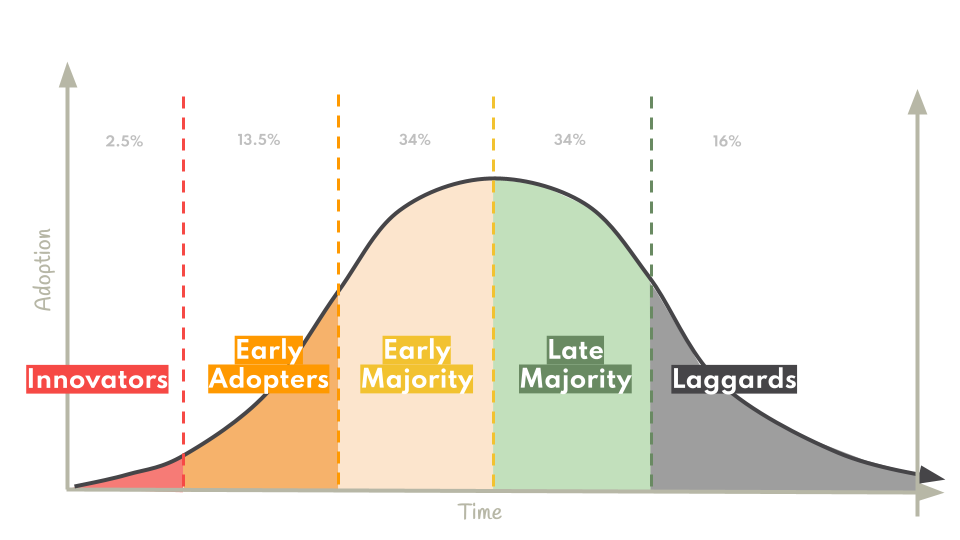
Every movement that changes the world rides a predictable curve…
The adoption bell curve starts with a tiny minority... the Innovators.
Then come Early Adopters. Then the majority follows... slowly.
Innovators are always the minority...
They see what others do not.
They are the ones who build the first rough bridge over a river... not because they were told to do so, but because they saw a problem that needed a solution in order to cross. Then others follow over and suddenly the bridge is "obvious." But it was not obvious when it was still an inconvenience and a pile of lumber.
Innovators live in that first stage... where there is no permission, no applause, and no certainty. They trade comfort for capability. They absorb the cost of learning so others can inherit the benefit of a working path.
This post is about that minority... the Innovators.
Now, place Adventism on that curve.
Entrepreneurship is in our roots
Our pioneers did not only preach new truths... they built the channels that carried those truths.
They built presses, papers, and distribution networks so the message could travel farther than a preacher ever could.
They built sanitariums and treatment rooms so health reform could be seen, touched, and trusted... not just theorized.
They built schools, farms, workshops, and practical industries so young people could learn to think and to do.
Adventism took root because innovators turned conviction into infrastructure.
So when we traded builders for committees, we did not just lose efficiency... we lost capacity.
This is why the "committee era" feels so different. Yes, committees can preserve... but they rarely invent. They can maintain... but they rarely pioneer. They can reduce risk... but they rarely produce the kind of faith that moves before the path is visible.
So what killed our entrepreneurial drive?
Several forces converged, and they reinforced each other.
It starts with education... but not just any education. It starts with the shift away from True Education, and toward a system designed to produce compliant professionals instead of courageous builders.
1) Disregarding True Education... the Madison pattern was lost
Madison was not just a school... it was a mindset. Learning and labor were integrated. Students were trained to think and to do, to solve problems, to build useful things, to support themselves, and to carry the message through practical industries.
That is entrepreneurship hardcoded into schooling... not as a class, but as culture.
When we drifted away from that model, we did not simply change curriculum... we changed the kind of characters that God's way produced.
"A return to simpler methods will be appreciated by the children... The lessons given the child should be, so far as possible, associated with objects that are continually before his eyes." Testimonies for the Church, vol. 6 (6T 179)
If we divorce education from practicality, we remove the entrepreneurial spirit of problem solving and wander into abstraction... and ultimately become dependent on external motivation.
And that is the opposite of entrepreneurship.
But this was not random... it was an intentional attack.
2) Seeking accreditation had a hidden cost…
After the Protestant Reformation threatened the Roman Catholic Church's monopoly on spiritual authority, the rulers of the age realized that ideas, once freed, could never again be contained. If information could set men free, then education had to be reshaped to keep them bound. What began as a system to illuminate minds was re-engineered into a mechanism to manage them.
This papal system of education, later adopted and refined by apostate Protestantism and state institutions alike, was designed to ensure that no new reform ideas could take root. It standardized thinking, produced loyal workers, and trained generations to repeat rather than reason.
"It has ever been the policy of the Papacy to sterilize the brains of teachers so that they cannot be impregnated with reform ideas... The Papal system of education makes them content to repeat set lessons to their students, as they themselves learned them in school, with no thought of making practical application. The students, in turn, go out to teach others the same rote they have learned, and thus the endless treadmill goes on, ever learning, but never getting anywhere." E. A. Sutherland, Studies in Christian Education (p. 72)
Over time, this design evolved into a global model. Modern education, particularly through Jesuit and state frameworks, became less about teaching people how to think and more about instructing them what to think.
"It developed an immense educational activity… It worked chiefly through its schools, of which it established and controlled large numbers. Every member of the order became a competent and practical teacher." Painter's History of Education (p. 166)
The creative and moral faculties of students were subdued through memorization and repetition.
"The following methods of teaching are characteristic of Jesuit schools: 'The memory was cultivated as a means of keeping down free activity of thought and clearness of judgment.'" Rosencranz's Philosophy of Education (p. 270)
This method of rote memorization became the hallmark of institutional learning. It dulled critical thought, replacing curiosity with compliance.
"For ages education has had to do chiefly with the memory. This faculty has been taxed to the utmost, while the other mental powers have not been correspondingly developed. Students have spent their time in laboriously crowding the mind with knowledge, very little of which could be utilized. The mind thus burdened with that which it cannot digest and assimilate is weakened; it becomes incapable of vigorous, self-reliant effort, and is content to depend on the judgment and perception of others."
Education (Ed 230.1)
Thus the current education system was perfected... not to inspire conviction, but to enforce conformity. Where the printing press once unleashed independent thought, standardized curricula sought to cage it again. Every textbook, every test, every credential became a quiet echo of that ancient purpose: to prevent another generation of reformers from challenging the Papal empire of thought.
The lasting effect of the educational weaponry of the counter-reformation is a compliant mentality. If you design a system to prevent another reformation, you also design a system to prevent another wave of entrepreneurs. Revolutions of faith and revolutions of enterprise are linked... both require conscience, courage, and dissent. Both threaten monopolies. Both refuse to worship at the altar of approval. A classroom that punishes dissent for sixteen years does not suddenly produce entrepreneurs at graduation.
What is clear is this... our educational system is largely why we do not have entrepreneurial minds.
Sending a naturally enterprising student into a standardization machine is like removing the teeth of a lion and then wondering why it will not hunt. What is being removed is curiosity and creativity.
Next...
3. Intelligence diverted into medicine... and enterprise narrowed
Our pioneers rightly elevated health reform and medical missionary work. But they did not just work in it... they founded the institutions.
At the turn of the 1900s, we were leaders in health entrepreneurship. Fast-forward to today, and in most places we no longer even own the healthcare systems that carry our brand.
Somewhere along the way, we distorted the pinnacle of success. We influenced many of our sharpest minds to be trained primarily to become employees inside large systems we no longer own.
"And the LORD shall make thee the head, and not the tail... and thou shalt be above only, and thou shalt not be beneath..." Deuteronomy 28:13
We were never meant to become the tail... servicing someone else's system, dependent on someone else's institutions, and slowly trained to think like employees instead of builders.
To be clear, we absolutely need health workers. We need them more than ever. But when medicine becomes the top rung of respected usefulness, a subtle drift happens. The best minds get optimized for credential ladders and institutional roles... and the world steps in to employ them.
Next...
4. Brain drain... the builders left because there was no tribe for them
Those who naturally feel called to use their entrepreneurial talents, and who overcome the peer pressure to fit the accepted Adventist roles... what happens to them?
In our culture, building is tolerated... but rarely championed.
And entrepreneurship does not survive on tolerance. It needs oxygen...
It needs peers who build, mentors who understand risk, and institutions that bless experimentation.
But when a church culture becomes permission-first, compliance-first, and reputation-protecting, innovators do what innovators always do...
They migrate to wherever there is a pathway for their calling. When the community offers no program, no peer group, no patience for iteration, no capital, and no protection for failure, Babylon becomes the only incubator.
So the ones wired to build went out into the world to find other builders... and the church experienced a slow brain drain.
The present result…
We became dependent on the very system we were warned to come out of.
Not only in where we live... but in how we think.
So when God calls His people to move, to simplify, to build, to separate... many cannot. Not because they do not believe, but because their entire economic life is tethered to Babylon.
And that is the practical outcome of losing entrepreneurship... the loss of mobility, the loss of conscience margin, and the loss of mission infrastructure.
Why present truth needs entrepreneurship…
When we look through the lens of present truth:
"Let us strive with all the power that God has given us to be among the hundred and forty-four thousand.
And let us do all that we can to help others to gain heaven."
Review & Herald, March 9, 1905
There are two parts... creating the environment to prepare characters for the final vindication, and helping others gain salvation.
These must be our motivation for entrepreneurship.
1. Obedience needs infrastructure
Country living is not merely a lifestyle trend... it is part of obedience and preparation. But people cannot leave Babylon if Babylon owns their paycheck.
If a man must choose between feeding his family and keeping the Sabbath, we have already failed him.
We need businesses that employ Sabbath keepers, train young people, create mobility, and fund mission without yoking conscience to corporate masters.
Home ownership, land, tools, skills... these are not luxuries. They are stabilizers of conscience.
"The sense of being owners of their own homes would inspire them with a strong desire for improvement. They would soon acquire skill in planning and devising for themselves; their children would be educated to habits of industry and economy, and the intellect would be greatly strengthened. They would feel that they are men, not slaves, and would be able to regain to a great degree their lost self-respect and moral independence." Adventist Home (AH 373.1)
This is not prosperity gospel. This is a blueprint for moral independence.
And the urgency is real.
"We are not ready for the issue to which the enforcement of the Sunday law will bring us." Testimonies for the Church (5T 713.4)
2. Missionaries need cover
We read how during the severest of persecution the Waldensians used business as a cover for evangelism:
"…they were welcomed as merchants where they would have been spurned as missionaries" Great Controversy (GC 71.1)
Paul understood this principle as well:
"As he worked at his trade, the apostle had access to a class of people that he could not otherwise have reached." The Acts of the Apostles (AA 351.3)
And the method is painfully simple:
"Invent some way of becoming acquainted with the people..."
The Upward Look (UL 171.6)
Entrepreneurship, when surrendered, is the entering wedge to use a customers temporal problem to gain their trust and gain access to point them to the Solution to eternal problems.
The Call…
Revival is not only a tearful altar call. Sometimes revival looks like a leap of faith.. faith in action…
God does not need a people who can only critique Babylon...
He needs a people who can demonstrate an alternative.
"By giving the gospel to the world it is in our power to hasten our Lord's return" The Desire of Ages (DA 633.3)
This is not a call to hustle.
It is a call to usefulness.
It is a call to build in faith.
It is a call to resurrect the pioneer spirit...
"We have no time now to give our energies and talents to worldly enterprises."
Testimonies for the Church, vol. 9 (9T 104.2)
The missing structure…
All the reasons above are why a venture studio is necessary.
Instead of the question, "Why are there so few innovators?"
Let's reframe the question to, "What container can we build to support innovators?"
A venture studio is a practical answer.
Not a centralized empire.
Not a committee layer.
A launchpad.
A place where innovators are not isolated, where builders find peers, where experimentation is blessed, where failure is not treated like heresy, and where the cost of building is reduced through shared tools, shared templates, and shared mentorship.
Think of it like this...
Pioneers used printing presses and sanitariums as missionary infrastructure.
A venture studio is the modern equivalent of that builder layer...